
“Why won’t this work?” she said with a frown.
say
기초 · 수준 1/10수능 18번 중 18번 출제모두 130번 나옴
That is to say that the reader finds the most when he knows just what he is looking for.
The best readers of serious matter have a similar eagerness to discover what the author has to say; they get the author’s question, and press on to find his answer.
It is certainly true that, by addressing a question to a collective (crowd intelligence), you may get a good answer more easily than by, say, researching the literature or asking a philosopher.
This is to say that, as soon as pictorial composition in space assumes the form of patterns of lines and colors successively perceived in time, composition becomes for us a rhythm.
It would be nice to say that sleep is nothing more than the time when a body rests, but that wouldn’t be quite right either.
Sleep is so important, yet so poorly understood, that it led one biologist to say, “If sleep doesn’t serve an absolutely vital function, it is the greatest mistake evolution ever made.”
Innovation provides one way of getting out of the competition, which is to say situations in which activities are not very profitable.
피이쉐어 설명
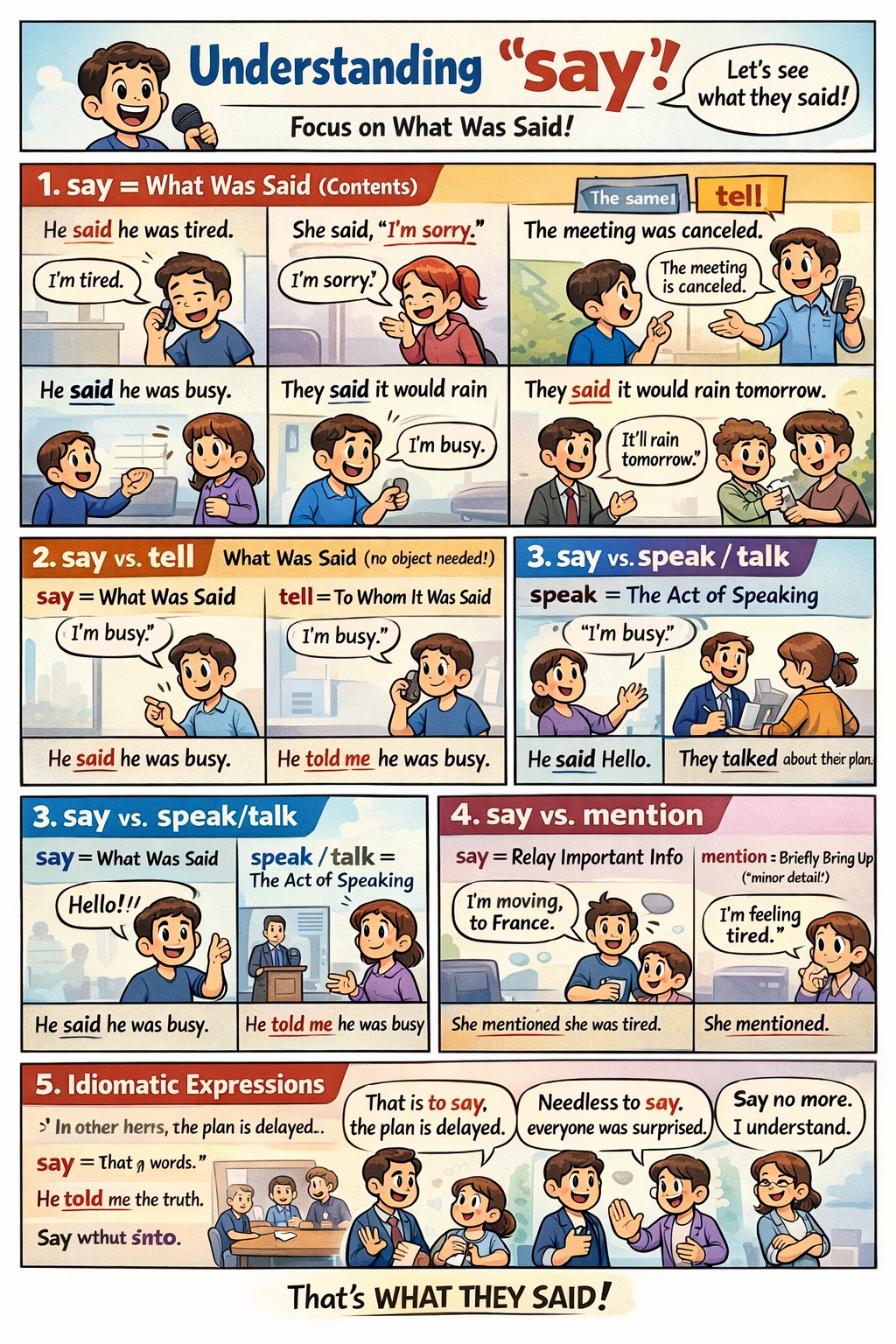
say는 영어에서 가장 기본이 되는 ‘말하다’ 동사입니다. 하지만 say의 핵심은 말하는 행위가 아니라,
say는 ‘내용이 무엇이었는가’를 말하는 동사입니다.
즉,
누가 말했는지
어떻게 말했는지
누구에게 말했는지
는 중요하지 않고, **“무슨 말이 나왔는가”**가 핵심입니다. 이 점 때문에 say는 다른 말하기 동사들의 기준점이 됩니다.
1. say — “이런 말이 나왔다” (내용 중심)
say는 말의 ‘내용’만 전달합니다. 그래서 say 뒤에는 말의 내용이 바로 옵니다.
He said he was tired. (그는 피곤하다고 말했다.)
She said, “I’m sorry.” (그녀는 “미안해”라고 말했다.)
He said the meeting was canceled. (그는 회의가 취소되었다고 말했다.)
She said she didn’t understand the question. (그녀는 그 질문을 이해하지 못했다고 말했다.)
They said it would rain tomorrow. (그들은 내일 비가 올 거라고 말했다.)
2. say vs tell — “내용” vs “대상”
say와 tell의 차이는 아주 단순합니다.
say → 무슨 말을 했는가
tell → 누구에게 말했는가
그래서 tell은 반드시 대상이 필요합니다.
He told me the truth. (O)
He told the truth. (X)
반면 say는 대상 없이도 됩니다.
He said the truth. (O)
He said he was busy. (그는 바쁘다고 말했다.)
He told me he was busy. (그는 나에게 바쁘다고 말했다.)
대상이 중요하면 tell, 내용만 중요하면 say입니다.
3. say vs speak / talk — “내용” vs “행위”
speak와 talk는 **말의 내용보다 ‘말하는 행위’**에 초점이 있습니다.
say → 무슨 말을 했는가
speak → 말을 하다 (공식적)
talk → 이야기를 나누다 (비공식적)
He said hello. (그는 “안녕”이라고 말했다.)
He spoke for an hour. (그는 한 시간 동안 연설했다.)
They talked about their plans. (그들은 계획에 대해 이야기를 나눴다.)
say = 내용 전달
speak / talk = 말하기 행위 자체
4. say vs mention — “전달” vs “슬쩍 언급”
mention은 중요하지 않은 정보를 짧게 덧붙일 때 씁니다.
say → 핵심 내용
mention → 곁다리 정보
She said she was moving abroad. (그녀는 해외로 이사 간다고 말했다.)
She mentioned she was tired. (그녀는 피곤하다고 슬쩍 언급했다.)
mention에는 항상 “중요하진 않지만 말은 해 둔다” 는 뉘앙스가 있습니다.
5. 특이한 표현 / 관용 표현
아래 표현들은 say의 ‘내용 전달’ 성격이 굳어진 표현입니다.
That is to say, the plan will be delayed. (즉, 그 계획은 연기될 것이다.)
Needless to say, everyone was surprised by the result. (말할 필요도 없이, 모두가 그 결과에 놀랐다.)
He is, so to speak, the backbone of the team. (말하자면 그는 그 팀의 중추다.)
Say no more. I understand what you mean. (그만 말해. 무슨 뜻인지 알겠어.)
That goes without saying. (그건 말 안 해도 당연하다.)
▶ 읽을 때의 처리 기준 (say)
문장 안에 나온 ‘말의 내용’을 가리킨다.
사고 기준 강화 (Reinforcement)
1. 다음 문장을 읽을 때, say에서 가장 먼저 붙잡아야 할 것은 무엇인가요?
He said he was tired.
정답: 말의 내용
해설: 누가 말했는지, 누구에게 말했는지는 중요하지 않다. 핵심은 **“피곤하다는 말이 나왔다”**는 내용이다.
2. 다음 문장에서 say는 무엇을 전달하나요?
She said, “I’m sorry.”
정답: 실제로 나온 말의 내용
해설: “미안하다”라는 말이 그대로 전달된다. say는 말의 태도나 관계를 설명하지 않는다.
3. 다음 두 문장의 차이는 무엇인가요?
He said he was busy.
He told me he was busy.
정답: 대상의 유무
해설: say: 내용만 전달 → 대상 없어도 된다. tell: 대상 필수 → 누구에게 말했는지가 핵심.
4. 다음 문장이 틀린 이유는 무엇인가요?
He told the truth. ❌
정답: tell에는 대상이 필요하기 때문
해설: tell은 “누구에게 말했는가”를 전제로 한다. 대상이 없으면 구조가 성립하지 않는다.
5. 다음 문장에서 say 대신 speak나 talk를 쓰기 어려운 이유는 무엇인가요?
He said hello.
정답: 말의 ‘내용’이 핵심이기 때문
해설: hello는 말의 내용이다. speak / talk는 말하는 행위나 대화를 말할 뿐, **“무슨 말을 했는가”**를 바로 담기 어렵다.
6. 다음 문장에서 say와 mention의 차이는 무엇인가요?
She said she was moving abroad.
She mentioned she was tired.
정답: 중요도의 차이
해설: say: 핵심 정보, mention: 중요하지 않은 정보를 슬쩍 덧붙임.
7. 다음 표현에서 say의 역할은 무엇인가요?
That is to say, the plan will be delayed.
정답: 앞말의 내용을 다시 풀어 말함
해설: say는 여기서도 여전히 ‘내용’을 다룬다. “다시 말하면”이라는 의미로, 설명을 명확히 만든다.
say 의 핵심 의미, 문형, 함께 쓰는 표현을 수능 문장과 함께 정리해 드립니다.
처음 만드는 단어는 30초쯤 걸립니다. 한 번 만든 설명은 바로 열립니다.영영 사전 Merriam-Webster
최근에 찾은 단어
이런 단어를 찾아보세요 수능에 자주 나온 단어
information
provide
without
nature
act
news
moment
image
community
price
everyone
seek
standard
addition
- 단어 카드의 스피커 단추를 누르면 발음을 들을 수 있습니다.
- 더 많은 단어는 수능 기출 단어에서 많이 나온 순서로 볼 수 있습니다.