
오늘의 한마디
Cell
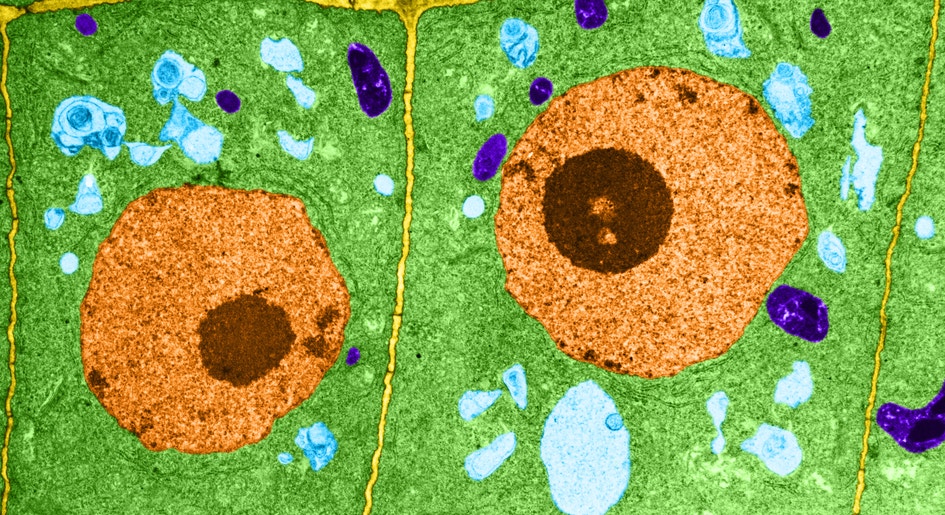
Cells are tiny "building blocks" of life. All living things are made up of cells. Some living things are made up of only one cell. They include amebas, paramecia, and bacteria. Plants and animals are made of millions and millions of cells. The human body contains more than 10 trillion cells. These cells are so small that they can be seen only with a microscope.
The size of cells
Cells are so small that they typically can be seen only with a microscope. Tens of thousands of cells could fit into this letter O.
A few cells are not that small, however. The yolk of a bird's egg is a single cell. The largest cell is the yolk of an ostrich egg. It is about the size of a baseball.
The shape of cells
There are many different kinds of cells. They may be shaped like coils, corkscrews, cubes, rods, saucers, or blobs. Most plant cells, for example, are shaped like cubes.
In living things with more than one cell, cells have different jobs. The shape of a cell depends on the type of job it does. In the human body, for example, cells that make up muscles are long and thin. Many of the cells in blood look like donuts with the holes filled in. Cells that form nerves have branches like trees.
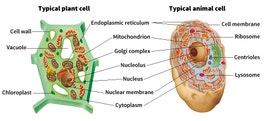
Structures of a cell
Parts of a cell
Cells have different parts. The outside of an animal cell has a thin covering called the cellmembrane <<MEHM brayn>>. It protects the rest of the cell. Inside the cell are two main parts called the nucleus <<NOO klee uhs>> and the cytoplasm <<SYtuh plaz uhm>> . Plant cells also have a nucleus, cytoplasm, and cell membrane. Outside the cell membrane, they also have a tough covering called the cell wall. The cell wall protects the rest of the cell. It helps to provide structure and support for the plant.
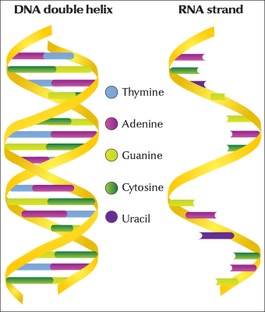
DNA and RNA
The nucleus is in the middle of the cell. It contains the cell's genetic program, the master plan that controls almost everything the cell does. The genetic program is "written" in the structure of a chemical substance called DNA ( d eoxyribo n ucleic a cid). Genes are units of DNA. The genetic program carried in DNA makes every living thing different from all others. It makes a dog different from a fish, a zebra different from a rose, and a willow different from a wasp. It also makes one person different from another.
A living thing's genes come from its parents. Genes carry information that makes the body look and work the way it does. For example, genes help determine how tall the body will grow and what color the hair and eyes will be. Genes also control many tasks that keep the body alive and healthy. The genes are in parts called chromosomes <<KROH muh sohmz>>. Chromosomes are mainly made up of DNA and proteins.
The cytoplasm is all the material between the nucleus and the cell membrane. The cytoplasm contains many smaller parts, each of which has a special job to do. Plants have green parts called chloroplasts <<KLAWR uh plasts>>. They use energy from sunlight to turn water and the gas carbon dioxide into sugar. The plant uses this sugar to live and grow. Plant and animal cells also have parts called mitochondria <<MY tuh KON dree uh>> . Mitochondria are the "power plants" of the cell. They convert food into a form of energy the cell can use to grow and do work.
Bacteria cells are much simpler than animal or plant cells. They have fewer parts. They do not have a nucleus. Instead, their genes lie in an area of the cell called the nucleoid <<NOO klee oyd>>. The nucleoid is not covered with a membrane.
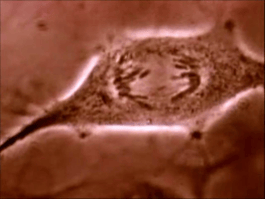
Cell division
The life of a cell
All cells are alive. They may "breathe" oxygen, use food, and get rid of wastes. They grow and make more of their own kind. In time, they die. Every day, for example, millions of cells in the body die and are replaced.
Cells take in the substances they need through their membrane. An animal cell gets its nourishment from what the animal eats. The blood carries the substances to the cells. A plant cell uses sunlight to make its own food.
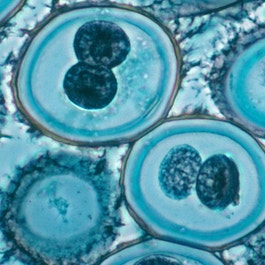
Mitosis in roundworm cells
Cells reproduce, or make copies of themselves. One cell becomes two cells by dividing in half. Then, these two cells divide again to make four cells. The cells keep dividing to make more and more cells. This is how living things grow and how they replace cells that die. This process is called mitosis <<mih TOH sihs>>.
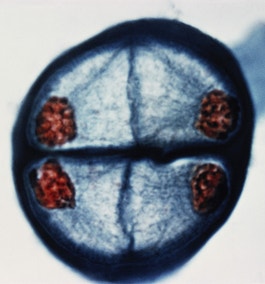
Meiosis in a lily pollen cell
Special sex cells are often involved in making new plants and animals. Sex cells have only a part of the genetic program. They must combine with a sex cell from another plant. The combined cell has a complete genetic program for making a new plant. The process that produces sex cells is called meiosis <<my OH sihs>>.
Cells and sickness
When a living gets sick, it is often because something is wrong with its cells. Cancer is a disease that happens when cells divide more than they should. The extra cells form a growth called a tumor. The tumor can take over one or more parts of the body. Doctors try to kill the tumor or remove it from the person's body.
Colds and the flu are diseases caused by viruses. Viruses are tiny germs that enter cells in the body and take them over. They force the cells to make more viruses. These viruses then go into other cells in the body and do the same thing.
Sometimes, a person is born with a disease. This can happen if genes in cells are damaged when they are passed from parents to their children.
http://worldbook.com