
단어 설명
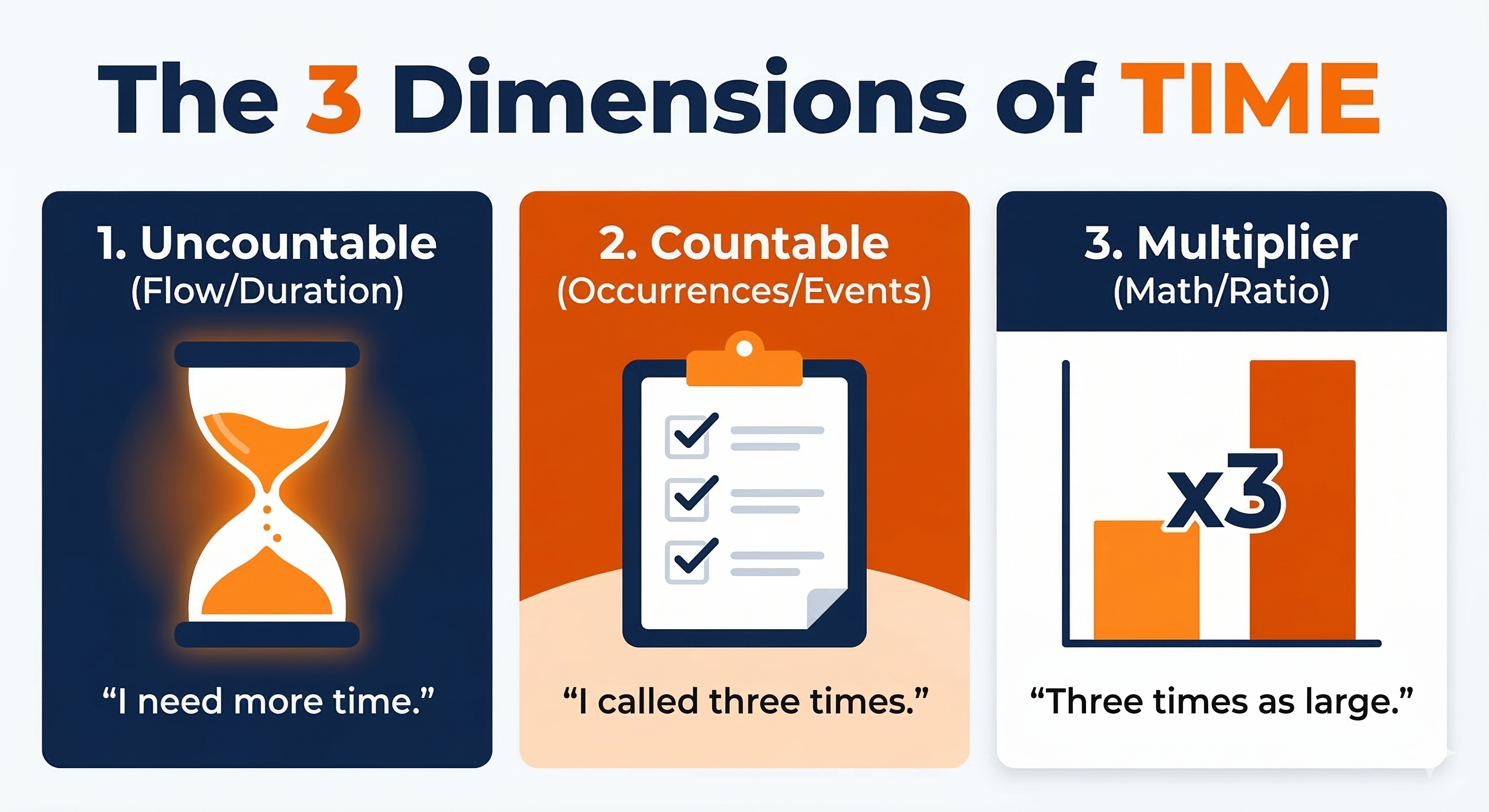
수능 영어에서 time은 문맥에 따라 서로 다른 세 가지 의미로 쓰입니다.
time이 단수인지 복수인지, 그리고 어떤 수식어가 붙었는지만 확인하면 문장의 구조가 보입니다.
[셀 수 없는 명사] time = 시간 (흐름, 여유, 기간)
time이 추상적인 '흐름'이나 '할애할 수 있는 여유'를 뜻할 때는 셀 수 없는 명사로 쓰입니다.
This takes time. (이 일은 시간[여유/기간]이 걸린다.)
Take your time. (서두르지 마라.)
There is no time to waste. (낭비할 시간[여유]이 없다.)
[수능 필수 함정] on time vs in time
The train arrived on time. (정시에, 예정된 시각에 딱 맞춰서)
We arrived in time to catch the train. (늦지 않게, 마감 시간 전에 여유를 두고)
[셀 수 있는 명사] time(s) = 횟수, 특정한 순간(타이밍)
time 앞에 a, first, last, three 같은 수식어가 붙으면 더 이상 흐르는 시간이 아닙니다. 특정한 경험의 '횟수'나 사건이 일어난 구체적인 '순간/경우'를 가리킵니다.
I called you three times. (나는 너에게 세 번 전화했다.)
This is my first time here. (여기는 처음[첫 번째 횟수]이다.)
Last time we met, it was raining. (지난번[우리가 만났던 그 특정 경우]에 비가 왔다.)
[수능 빈출] a few vs quite a few
a few times는 '두세 번 정도'로 많지 않음을 뜻하지만, quite a few는 '적을 줄 알았는데 의외로 꽤 많다(many)'는 뜻으로 해석해야 독해가 꼬이지 않습니다.
[시간/순간의 명사] time when
There was a time when people believed this. (사람들이 이것을 믿던 시절/때가 있었다. 관계부사 when과 결합하여 '특정 시기'를 나타냅니다.)
[복수형 고정] times = 시대/국면, 그리고 배수(곱하기)
수능 지문에서 복수형 times는 특수한 두 가지 의미로 굳어져 쓰입니다.
시대 / 국면 (Eras/Conditions): 세상의 흐름이나 상황 전체를 묶어 말할 때 씁니다.
Modern times (현대) / Hard times (어려운 시기)
We live in difficult times. (우리는 어려운 시대[국면]를 살고 있다.)
[수능 도표 필수] 배수 / 곱하기 (Multipliers): 25번 도표 문제에서 '몇 배 차이가 나는지'를 나타내는 수학적 도구로 쓰입니다.
The rent here is three times the price of my previous apartment. (여기 월세는 예전 아파트 가격의 3배이다.)
This new laptop is three times as fast as my old one. (이 새 노트북은 예전 것보다 3배나 빠르다.)
수능에 직결되는 time 핵심 관용구
spend time -ing / with 명사: 시간을 보내다
They spent time playing games. (그들은 게임을 하며 시간을 보냈다.)
have a hard time -ing: ~하느라 고생하다, 애를 먹다
They had a hard time understanding the new theory. (그들은 새로운 이론을 이해하느라 고생했다.)
It is time to V / It is time for N: 이제 ~해야 할 때(타이밍)이다
It is time to leave. (이제 떠날 때다.)
※ 심화 표현: It is high time + 주어 + 과거동사 (이제 정말 ~했어야 할 때다. - 과거형을 써서 이미 늦었음을 꼬집으며 시급함을 강조합니다.)
It is high time we left. (이제 정말 우리가 떠나야 할 때다.)
at a time / at one time: 형태는 비슷하지만 뜻은 완전히 다릅니다. at a time은 '한 번에', at one time은 '한때(과거의 어느 시절)'를 뜻합니다.
Take it one step at a time. (한 번에 한 걸음씩 나아가라.)
At one time, this area was a forest. (한때, 이 지역은 숲이었다.)
in no time / at no time: in no time은 '순식간에(금방)'라는 뜻이고, at no time은 '결코 ~않다(never)'라는 뜻의 강한 부정어입니다. (수능 어법: at no time이 문장 맨 앞에 오면 주어와 동사가 의문문 어순으로 도치됩니다.)
He finished the test in no time. (그는 순식간에 시험을 끝냈다.)
At no time did the company ignore the safety regulations. (회사는 결코 안전 규정을 무시하지 않았다.)
over time: 시간이 흐름에 따라. (단순한 횟수나 시간의 초과가 아니라, 긴 시간의 선을 따라가는 '점진적인 변화 과정'을 나타냅니다.)
The village had changed a lot over time. (그 마을은 시간이 흐름에 따라 많이 변했다.)
▶ 읽을 때의 처리 기준 (time)
time이 보이면 시계를 떠올리지 말고, 이 단어가 지금 ‘시간의 흐름’인지, ‘횟수나 특정 순간’인지, 아니면 ‘시대’나 ‘배수’를 뜻하는지 먼저 구분한다.
[1초 스피드 체크 : Speed Check]
▶ 다음 문장들을 읽고, time이 맡은 진짜 역할에 1초 만에 체크해 보세요.
"We arrived (on / in) time for the concert, so we didn't miss the opening."
Q. 괄호 안에 들어갈 알맞은 단어와 그 이유는?
[ ] A. 정각에 딱 맞춰 도착했다는 뜻이므로 on이다.
[ ] B. 시작하기 전에 '늦지 않게' 여유를 두고 도착했다는 뜻이므로 in이다.
정답: B / [해설] 콘서트 오프닝을 놓치지 않았다는 문맥상, 마감 시간 전에 간신히 또는 늦지 않게 도착했다는 뜻의 in time이 자연스럽습니다.
"The population of the city is now three times what it was in 2010."
Q. 수능 도표 지문에서 times를 만났을 때 독자의 올바른 뇌 반응은?
[ ] A. "2010년에 세 번 일어났던 일이구나"라고 횟수로 해석한다.
[ ] B. "아, 2010년 인구를 기준으로 삼아 3배(곱하기 3)만큼 커졌다는 뜻이구나!"라고 크기의 배율로 계산한다.
정답: B / [해설] 숫자 + times 구조가 비교 대상과 결합하면 100% '배수(몇 배)'를 나타내는 수학적 스위치가 됩니다.
"At no time did the company ignore the safety regulations."
Q. 이 문장의 올바른 해석과 문법적 특징은?
[ ] A. "시간이 없을 때 회사는 규정을 무시했다"는 뜻이다.
[ ] B. "회사는 결코 규정을 무시하지 않았다"는 뜻이며, 부정어(At no time)가 앞으로 나와 did + 주어 + 동사원형으로 도치된 구조이다.
정답: B / [해설] at no time은 never와 같은 강한 부정어입니다. 문장 맨 앞에 오면 반드시 의문문 어순으로 도치가 발생합니다.
"They had a hard time (to understand / understanding) the new theory."
Q. 괄호 안에 들어갈 알맞은 형태와 그 이유는?
[ ] A. 앞으로 이해해야 하므로 미래 지향적인 to understand이다.
[ ] B. 관용적으로 굳어진 표현이며, 그 시간을 겪어내는 과정을 나타내므로 understanding이다.
정답: B / [해설] have a hard time 뒤에는 반드시 -ing(동명사/현재분사)가 와서 '그 행동을 하는 과정 속에서 애를 먹다'라는 뉘앙스를 완성합니다.
[심층 사고 훈련 : Deep Dive]
Q1. "There is a time to work and a time to play." 이 문장에서는 추상적인 '시간'을 뜻함에도 불구하고 왜 앞에 관사 'a'가 붙었을까요?
정답: 여기서 time은 멈추지 않고 흐르는 연속적인 시간이 아니라, 일해야 할 '특정한 시점/기회/타이밍'을 딱 떼어내어 가리키기 때문입니다.
해설: time이 어떤 특정한 성질을 가진 '순간'이나 '국면'으로 한정될 때는 셀 수 있는 명사 취급을 받아 a가 붙거나 복수형이 될 수 있습니다.
Q2. 수능 지문에서 "The landscape has changed significantly over time."이라는 문장을 만났습니다. 여기서 over time을 '시간 초과'나 '몇 번에 걸쳐서'로 해석하면 안 되는 이유는 무엇인가요?
정답: over time은 특정한 횟수나 마감 시간이 아니라, 과거부터 지금까지 '시간이 점진적으로 흐르면서'라는 '과정 전체'를 나타내는 관용구이기 때문입니다.
해설: over는 '~너머, ~에 걸쳐'라는 덮는 이미지를 가집니다. 따라서 over time은 긴 시간의 선을 따라가며 서서히 일어나는 변화를 묘사할 때 쓰입니다.
독해 스위치 ON (사고의 흐름)
수능 지문에서 time을 만났을 때 기계적으로 '시간'이라고 해석을 끼워 맞추려 하면 글의 뼈대와 수치가 무너집니다. time은 시간의 흐름, 사건의 횟수, 그리고 배율을 가르는 논리적 렌즈입니다. 다음 수능 기출 문장들을 읽으며 time을 만나는 순간 그것이 무엇을 뜻하는지 구분해 보는 연습을 해봅시다.
[기출 문장 1: 추상적 흐름으로서의 셀 수 없는 time]
Otherwise, waiting time will wipe out any time savings from a faster service. (2026 수능 23번)
사고의 흐름:
waiting time will wipe out: "기다리는 시간이 없애버릴 것이다."
any time savings: [독해 스위치 작동!] "여기서 time savings는 '횟수'나 '시대'가 아니지. 빠른 서비스로부터 얻는 '추상적인 시간적 여유/절약'을 뜻하는구나. 셀 수 없는 양의 개념으로 부드럽게 넘어가자."
[기출 문장 2: 점진적인 시간의 흐름을 나타내는 관용구 over time]
The village had changed a lot over time. (2026 수능 19번)
사고의 흐름:
changed a lot: "많이 변했다."
over time: [독해 스위치 작동!] "특정한 한 번의 횟수가 아니라, 과거부터 지금까지 '시간이 흐름에 따라(시간이라는 선을 길게 덮으면서)' 점진적으로 변했다는 전형적인 관용구구나!"
[기출 문장 3: 횟수/배율을 의미하는 복수형 times]
In the category of Less Often, the percentage of teenagers who spent time with friends through talking on the phone was more than twice that of teenagers who did so through text messaging. (2026 수능 25번)
사고의 흐름:
spent time with friends: "친구들과 시간을 보낸 (흐름/여유로서의 time)"
was more than twice: [독해 스위치 작동!] "twice (two times)가 나왔네! 이건 시간이 아니라 배율(곱하기)을 뜻하는 도표 핵심어다. 텍스트 메시지를 보낸 십 대들의 비율(that)을 기준점으로 잡고, 그 수치에 곱하기 2(두 배)를 초과(more than)한다고 정확히 계산해서 읽어야 해!"